
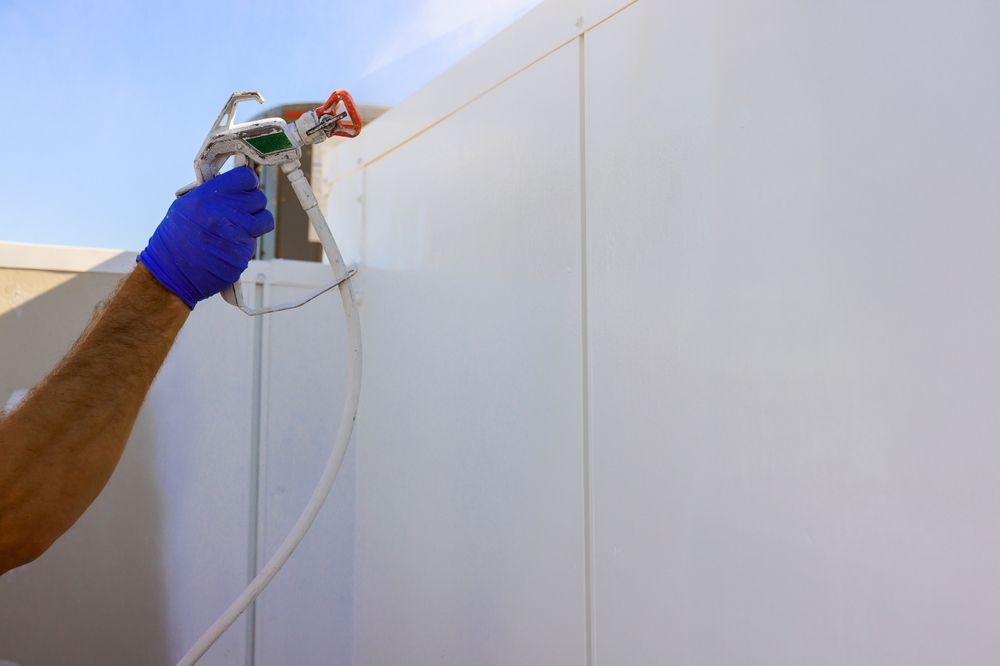
Coverage That Handles Large Surface Area
Spray-Applied Exterior Painting in Castle Rock for homes and buildings where speed and seamless finish matter across expansive facades
Large exterior surfaces—multi-story siding, commercial facades, or homes with complex architectural detail—demand application methods that deliver uniform coverage without the lap marks and brush strokes that show up when roller or brush work stretches across hundreds of square feet. Spray application accelerates coverage and produces seamless finish on those expansive areas, but the outcome still depends entirely on prep work completed before the spray rig runs. George Meyer Paint applies spray-applied exterior paint with the same surface assessment, caulking, sanding, and spot priming that defines the company's brush and roller work, because Front Range UV and wind exposure punish any shortcut regardless of how the topcoat is applied.
The process mirrors standard exterior prep but scales equipment to match surface area—power washing removes dirt and loose material, caulking seals gaps around trim and siding joints, sanding levels problem areas, and spot priming treats bare wood or patches before spray equipment is deployed. Multiple coats are applied per estimate, and Benjamin Moore or Sherwin-Williams specifications ensure the finish contains UV inhibitors and flexible resins that resist photodegradation and thermal stress. Spray application achieves uniform film thickness across large, uninterrupted surfaces where roller texture or brush overlap would create visible inconsistencies.
Request an exterior assessment to determine whether spray application suits your property's surface type and access constraints.
Why Application Method Follows Prep Quality
Spray equipment delivers paint faster and more uniformly than brush or roller, but it doesn't compensate for inadequate prep—gaps that weren't caulked still allow moisture intrusion, surfaces that weren't sanded still reject adhesion, and areas that weren't primed still soak up topcoat unevenly. The spray rig simply applies whatever prep quality exists on the substrate, which is why surface assessment and gap sealing happen first. Proper prep creates the smooth, sealed surface that allows spray application to build consistent film thickness without thin spots or overspray waste, and multi-coat systems ensure adequate coverage even on porous or textured substrates like stucco or rough-sawn siding.
George Meyer Paint has maintained spray equipment and crew training since 2011, adapting the method to projects where large surface area or architectural complexity makes brush and roller work impractical. Once finished, exteriors show no lap marks or texture variation across siding panels, trim edges remain crisply defined without overspray bleeding, and color uniformity holds across the entire facade regardless of sun angle or viewing distance.
Estimates specify which surfaces receive spray application versus brush detail work, how many coats are included, and what masking or protection is required for adjacent surfaces like windows, landscaping, or hardscaping. Some projects combine spray for large open areas with brush work for trim and detail, optimizing speed without sacrificing edge precision.
Common Questions About Spray Painting
Spray-applied finishes raise questions about prep requirements, overspray control, and how the method compares to traditional brush and roller application on Castle Rock properties.
What prep work is required before spray application begins?
The same prep used for brush and roller work applies—surface assessment, caulking of gaps and joints, sanding of problem areas, and spot priming of bare wood or patches—because spray equipment doesn't improve substrate condition, it only applies topcoat faster.
How is overspray controlled during exterior spray painting?
Adjacent surfaces like windows, doors, landscaping, and hardscaping are masked with plastic sheeting and tape, and low-pressure spray equipment minimizes airborne drift; wind conditions in Castle Rock are monitored to schedule application during calm periods.
When does spray application make sense versus brush and roller?
Spray is most effective on large, uninterrupted surfaces like siding panels, stucco walls, or multi-story facades where uniform coverage and speed matter; brush and roller remain preferable for small areas, intricate trim, or projects where masking adjacent surfaces would be prohibitively time-consuming.
What surface types work best with spray-applied paint?
Smooth siding, textured stucco, and rough-sawn wood all accept spray application well as long as proper priming seals the substrate; porous or heavily textured surfaces may require additional coats to achieve full hide and adequate film thickness.
How many coats are included in spray-applied exterior projects?
Multiple coats are specified per estimate based on substrate type, color change, and durability requirements; most projects include at least two finish coats over primer to build the film thickness that resists UV degradation and weather exposure over the warranty period.
George Meyer Paint evaluates each property individually to determine whether spray application delivers practical advantages over traditional methods, prioritizing finish quality and prep standards over speed alone. Arrange a site visit to review your exterior's surface area, access constraints, and whether spray application fits your project scope.